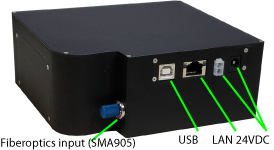
What is Ariel?
Ariel is an astigmatism-corrected fiber-optic spectrometer using an unfolded, fixed and rugged Czerny-Turner optical bench with 80 mm focal length. It uses a 2048-pixel CMOS detector, USB 2.0 and 1 Gb LAN communication, and performs data correction and conditioning in firmware.
Why Ariel?
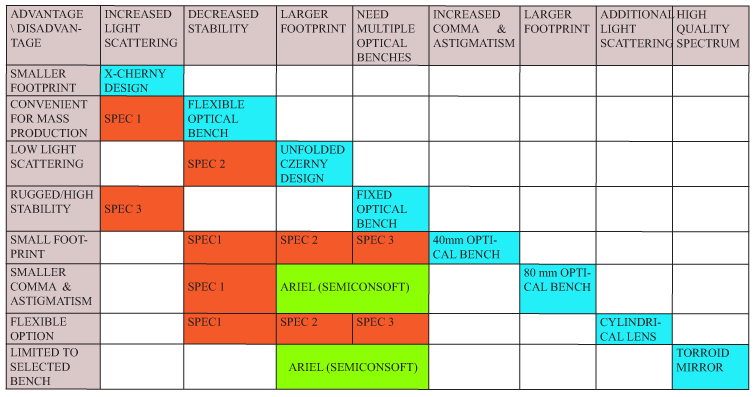
Many compact fiber-optic spectrometers are optimized for low cost and small size. In an MProbe system, the spectrometer is not a commodity part; it determines signal quality, measurement speed, repeatability and the ability to resolve weak interference fringes. Ariel uses different engineering trade-offs in optical configuration and calibration.
Optical design choices
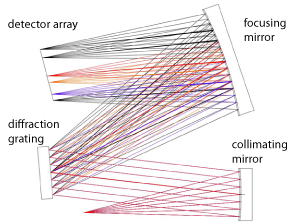
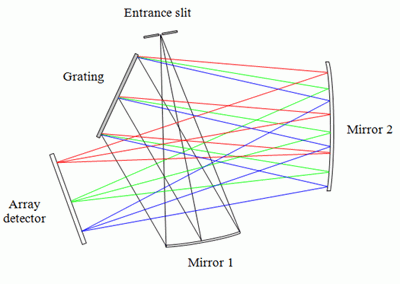
An unfolded Czerny-Turner design keeps the optical paths separated, reducing scattered light compared with crossed-path compact designs. A fixed optical bench improves mechanical and thermal stability, which matters in industrial environments where vibration and drift can make annual recalibration difficult.
Ariel's 80 mm optical bench avoids the high grating dispersion typically needed in a smaller 40 mm bench. That helps reduce astigmatism and coma while preserving clean peak shape across the spectrum.
Astigmatism correction
Off-axis light reflected from a spherical mirror focuses at different positions in the sagittal and meridional planes. A point at the entrance slit becomes a line at the sensor, reducing light collection and degrading spectral shape. Ariel uses a toroidal mirror to correct astigmatism without adding a separate cylindrical-lens element.
Data calibration and correction
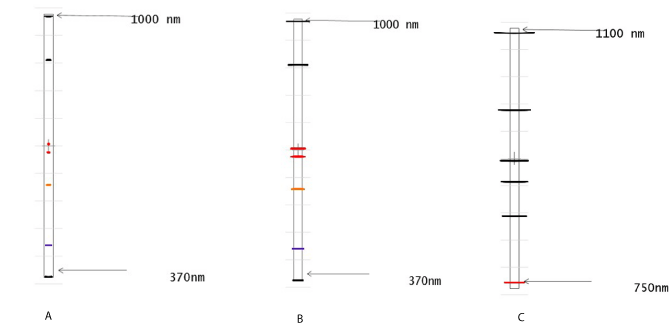
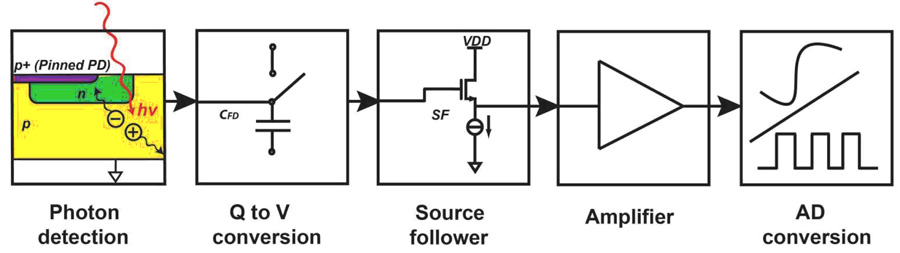
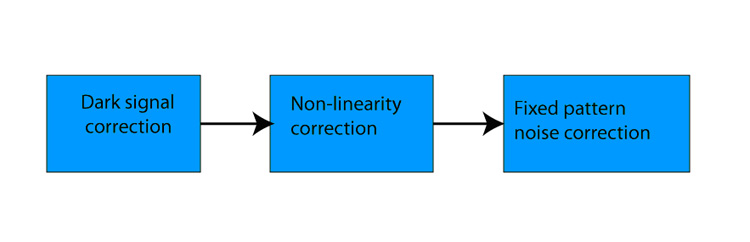
Wavelength calibration is essential, but active CMOS detector arrays need more than wavelength correction. Each pixel has its own charge-to-voltage conversion and source follower, so dark signal, non-linearity and fixed-pattern noise vary by pixel. Ariel corrects these effects in firmware using factory calibration data.
Dark signal correction
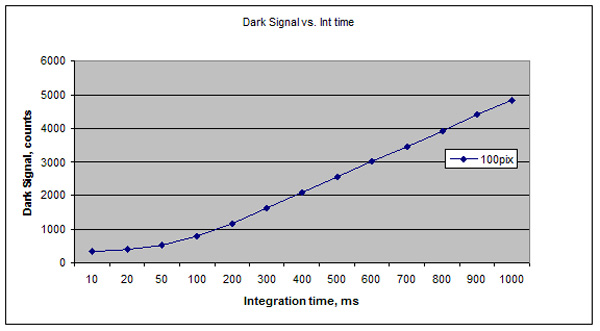
Dark signal depends on integration time and temperature. In CMOS detectors, each pixel can have a different dark-current level and a different rate of change. Ariel stores calibrated correction coefficients and applies them based on detector temperature and integration time.
Non-linearity and fixed-pattern noise
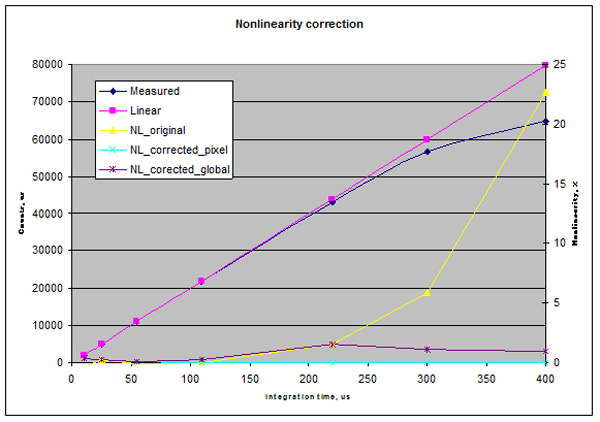
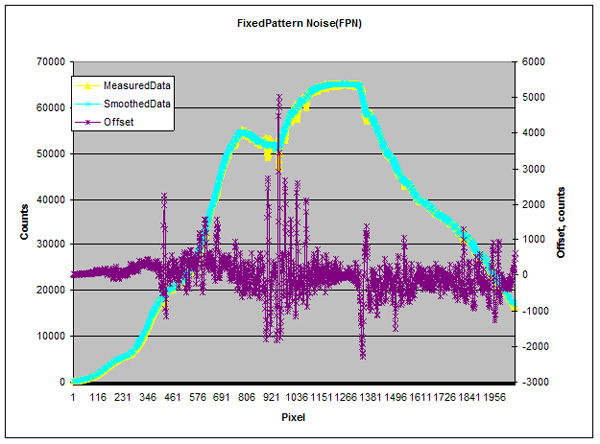
The S11639 CMOS detector is close to linear at lower signals, but non-linearity increases near the top of the range and differs slightly pixel to pixel. Ariel corrects non-linearity through factory calibration. Fixed-pattern noise is also present in CMOS arrays; baseline calibration corrects much of it, and optional FPN calibration can further improve spectrum smoothness.
Related system: Ariel spectrometer.