Ariel is a fiber-optic spectrometer for industrial and R&D desktop applications. It uses an unfolded Czerny-Turner system on an 80 mm optical bench, with a toroidal mirror for astigmatism correction. The fiber input is SMA 905, and it offers Gigabit LAN and USB 2.0 connections plus an extensive auxiliary port for communicating with other devices. It's a rugged instrument with a fixed optical bench - no moving or adjusting parts. Solid metal construction gives it mechanical and thermal stability in a 144×133 mm, 55 mm-tall, 800 g package.
Ariel's low-aberration design delivers clean, symmetrical peaks across the full spectrum with improved sensitivity at short and near-infrared wavelengths. Coupled with fast integration times, onboard signal conditioning and LAN connectivity, that makes it well suited to demanding industrial and R&D work.
Why we designed our own
There are several mass-produced fiber-optic spectrometers to choose from. A spectrometer can be viewed as a commodity or as a critical component - it depends on the application. In our system, it is critical, so we care deeply about its performance and stability. Commodity spectrometers make engineering trade-offs aimed at the largest market segment: smallest footprint and lowest manufacturing cost, including simplified assembly and calibration. Our target is different - fast acquisition of high-quality spectroscopic data with all corrections done in firmware - so we made a different set of trade-offs, chiefly in optical design and in data correction.
Optical design choices
- Unfolded vs. cross Czerny-Turner. The unfolded, symmetrical design separates the optical paths and greatly reduces light scattering, at the cost of a slightly larger footprint. A cross design is more compact but its crossed paths and close element spacing increase scattering.
- Fixed vs. flexible bench. A flexible bench with adjustable grating and mirror positions saves cost and adds mass-production flexibility, but reduces stability and typically needs annual wavelength recalibration - a challenge in a vibrating industrial environment. Ariel's fixed bench sets every component in epoxy for a very rugged instrument, dedicated to a specified wavelength range and resolution.
- 80 mm vs. 40 mm focal length. To reach the same resolution, a 40 mm bench needs a higher-dispersion grating (600 vs. 300 g/mm), which raises the angle of incidence on the mirror and increases astigmatism and coma. Ariel's 80 mm bench avoids that trap.
- Toroidal-mirror astigmatism correction. Off-axis light from a spherical mirror focuses differently in the sagittal and meridional planes, turning a slit point into a line and losing up to ~70% of the light. A toroidal mirror corrects this without adding an element, increasing light collection 4–5× and reducing coma for clean, symmetrical peaks.
Calibration and correction - done in firmware
Wavelength calibration is essential, but it's only the beginning. Ariel handles dark-signal correction, non-linearity correction, fixed-pattern-noise (FPN) correction and data processing such as boxcar averaging - all in firmware. This matters especially for active CMOS detector arrays, where each pixel behaves as an independent detector.
- Dark-signal correction. Dark current depends on integration time and temperature, and differs pixel-to-pixel in a CMOS detector. Ariel stores per-temperature, per-integration-time regression coefficients and applies them automatically, so measurements can be taken without a separate dark spectrum.
- Non-linearity correction. CMOS response is linear at low signal but non-linear near saturation, and slightly different for every pixel. Ariel achieves residual non-linearity < 0.4% (99.6% linearity) with global correction, and ~99.8% with per-pixel correction.
- Fixed-pattern noise. Always present in CMOS arrays; typically ~2% and up to 10% on some pixels. Baseline calibration corrects much of it, and an optional FPN calibration improves the spectrum further when needed.
Spectrometer specification and thickness measurement
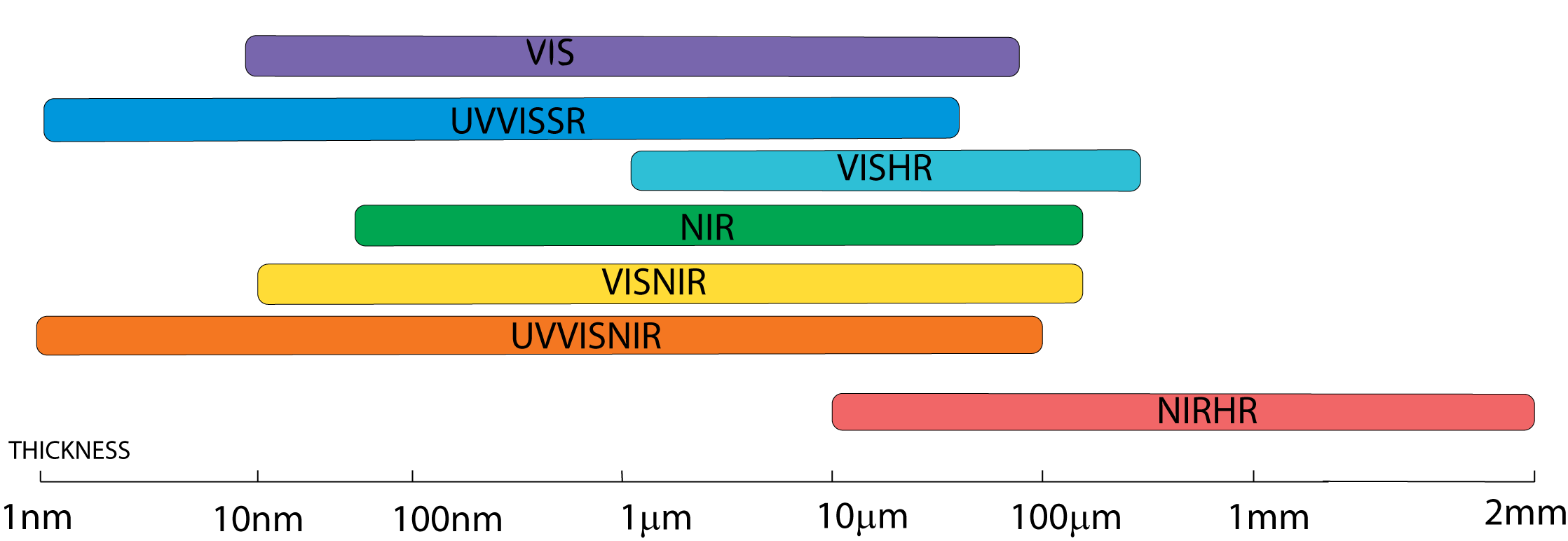
Spectrometer performance connects directly to what you can measure. With a 16-bit ADC and the CMOS S11639 detector's ~13–14 ADC-count read noise, Ariel reaches a dynamic range of ~5000 - enough to measure reflectivity from 100% down to ~0.02%, and to resolve ~0.1% interference fringes at low reflectivity. The default MProbe recipe (10 averages, 5-pixel boxcar) raises effective dynamic range to ~35,000 and SNR to ~2500, trading a little measurement time and resolution. Wavelength resolution is chosen for the target thickness range: with a 2048-pixel detector giving ~0.3–0.4 nm per pixel and a ~10 µm RMS spot, a 20 µm slit achieves < 1 nm resolution. See The Technology for how these spectra become thickness and n, k.
Basic specification
| Wavelength range | 380–1000 nm (Vis); 450–1050 nm (VisX); 200–1000 nm (UVVis) |
| Wavelength resolution | 1 nm (20 µm slit) |
| Dynamic range | 5000 |
| Minimum integration time | 10 µs |
| Detector | CMOS, 2048 pixels |
| Optical system | Unfolded Czerny-Turner, fixed, 80 mm bench |
| Diffraction grating | 400 g/mm blazed at 500 nm (300 g/mm dual-blazed option) |
| Astigmatism correction | Toroidal mirror |
| Input fiber connector | SMA 905 |
| ADC | 16-bit, 10 MHz |
| Connection | Gigabit LAN, USB 2.0 |
| Auxiliary port | 4× GPIO, I²C, 2× SPI, 4× PWM, 4× DAC, trigger, strobe |
| Onboard conditioning | Averaging, boxcar, non-linearity, dark-signal and fixed-pattern-noise correction |
| Power | 24 V DC |