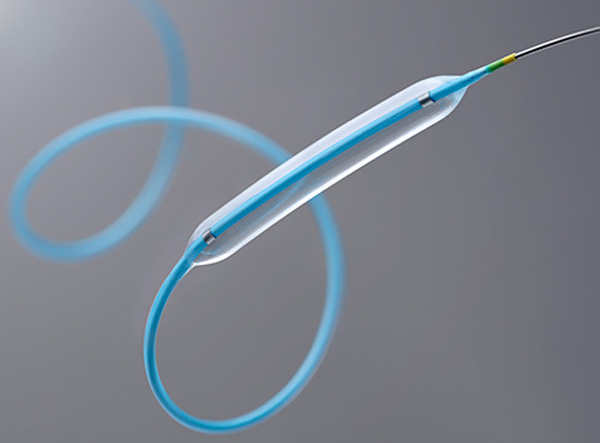
Catheter balloons are made from polymer tubes with original wall thickness of 0.12–0.5 mm; radially expanded in a mold, single-wall thickness becomes 0.012–0.050 mm. The wall follows a thickness profile along the balloon's length to distribute pressure correctly - an angioplasty balloon, for example, is thinner in the center for higher pressure there.
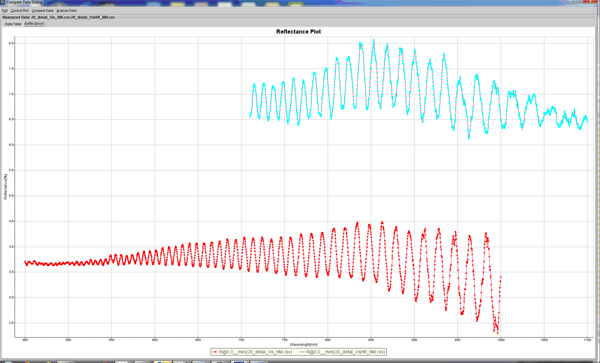
Wall thickness is measured non-contact at multiple points with a small spot (0.008–0.040 mm depending on diameter). Measuring an inflated balloon gives the best contrast, but a deflated balloon can also be measured. Either the Vis (400–1000 nm) or VisHR (700–1100 nm) range is used depending on wall thickness and material.
Why use MProbe 40 MSP?
- Small-spot measurement is required for balloon-wall measurement, typically ~10–40 µm depending on balloon diameter and material.
- The MProbe MSP system supports up to four objectives, with calibration stored for different configurations.
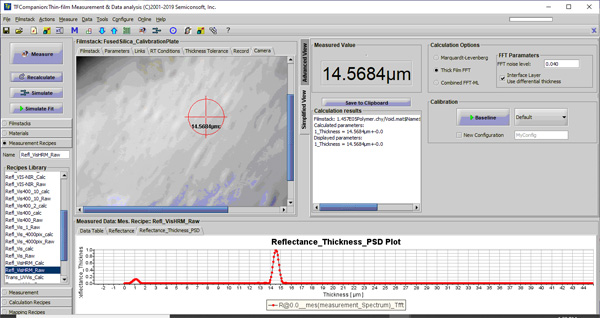
- The camera image and reticle make it easy to navigate to the desired measurement location.
- Results can be displayed directly on the image.
- Vis (400–1000 nm) or VisHR (700–1100 nm) ranges can be used, selected by wall thickness and material.
- The measurement is quick, non-contact and can be customized for automated measurements.
Measured with: MProbe 40 Vis-MSP (MProbe 40).