Thin polyester coating protects steel sheets used in hi-tech manufacturing from corrosion; thickness and uniformity testing is usually done offline to adjust the process. Polyester is notoriously hard to measure optically because of its texture and micro-non-uniformity. MProbe Vis-MSP localizes the measurement in a small spot (~20–40 µm), and advanced data analysis reduces texture artifacts to extract thickness. For non-transparent, high-scattering white coatings, the NIR range (MProbe NIR-MSP, 900–1700 nm) is used with a small spot. Typical coating thickness of ~5–10 µm matches the MSP system range well.
Measurement approach
Transparent polyester on steel can be measured in the visible range using small-spot MSP optics. White or highly scattering polyester on aluminum is better measured in the NIR range, where scattering is reduced and the interference signal is easier to recover. The measurement is typically performed offline so the coating process can be adjusted based on thickness and uniformity results.
Why use MProbe MSP?
- Small-spot measurement localizes the measurement area and reduces texture and micro-non-uniformity artifacts.
- Vis-MSP is suitable for transparent polyester coatings; NIR-MSP is used for high-scattering white coatings.
- Advanced data analysis extracts thickness from difficult spectra on textured metal sheets.
- Typical ~5–10 µm polyester coatings fall within the MSP measurement range.
Basic specification
| Recommended system | MProbe Vis-MSP / NIR-MSP |
| Wavelength range | 400–1000 nm (Vis); 900–1700 nm (NIR) |
| Typical coating thickness | ~5–10 µm |
| Typical spot size | ~20–40 µm |
| Precision | < 0.01 nm or 0.01% |
| Accuracy | < 1 nm or 0.2%, filmstack dependent |
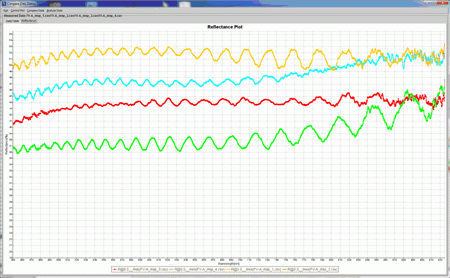
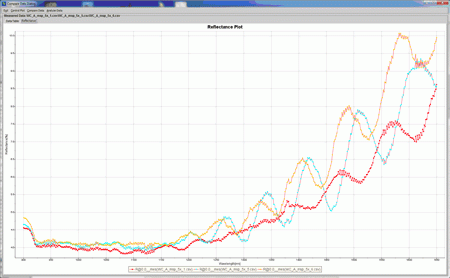
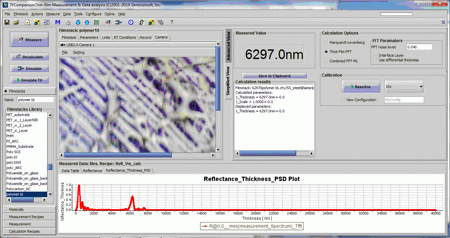
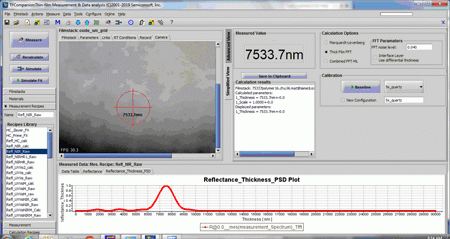
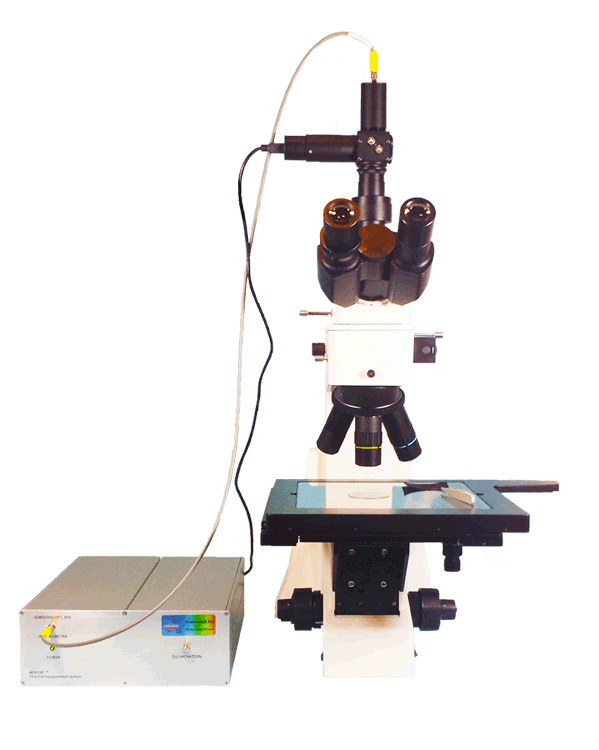
Measured with: MProbe Vis-MSP / NIR-MSP (MProbe 40).