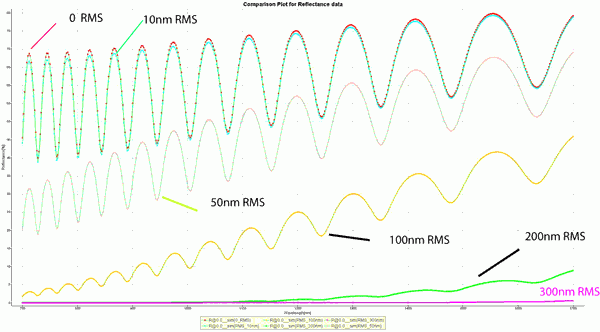
Surface roughness and thickness non-uniformity are the two main factors that degrade spectroscopic-reflectance thickness measurement, yet they are common in real cases like coatings on metals. Both depend on measurement area, so reducing the spot size reduces the effective roughness and non-uniformity within the spot. Roughness increases light scattering (worse at short wavelengths), so the long-visible and NIR range (700–1700 nm) is better suited; interference degrades noticeably for RMS > 100 nm. Because a rough surface has smooth areas at small scale, a 2 µm spot can practically eliminate the roughness effect. Thickness non-uniformity within the spot behaves like a multilayer stack - the optical phase is convoluted and de-convoluted (via FFT) rather than averaged - so a smaller spot again makes measurement possible. This same physics lets NIR measure solar absorbers (CIGS, CdTe) that look opaque in the visible. The smallest spot isn't always best; it's optimized per application.
Surface roughness and wavelength
Light-scattering effects increase at shorter wavelengths. Simulated reflectance spectra for a 5 µm polymer film show accelerated degradation of intensity and interference at shorter wavelengths as roughness increases. In practice, using a smaller spot and, when appropriate, a longer wavelength range helps recover a usable interference signal.
Thickness non-uniformity
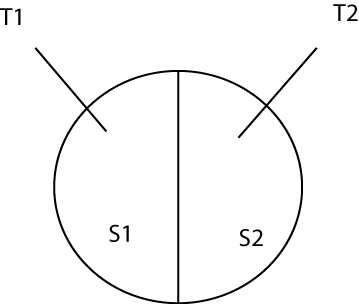
Coating thickness non-uniformity within the measurement spot can make the reflectance behave like a multilayer filmstack. If the thickness variation is large enough, the optical phase and interference are scrambled and thickness measurement is no longer possible.
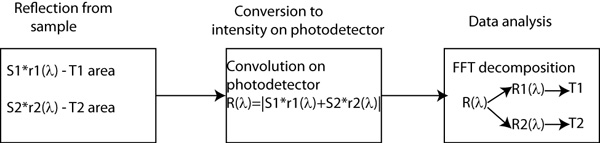
When reflectances from two areas in the spot reach the photodetector, they are combined and converted to intensity. The optical phase is not simply averaged away; during FFT analysis, the signal can be decomposed and individual thicknesses extracted. If thickness changes randomly or continuously within the spot, however, deconvolution produces a continuum of thicknesses. Reducing the measurement spot size reduces that variation and makes the measurement possible again.
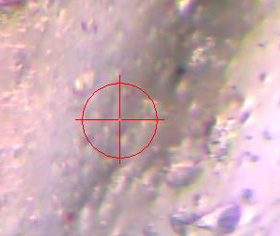
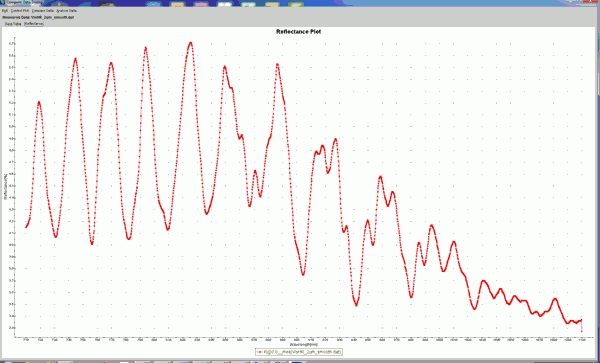
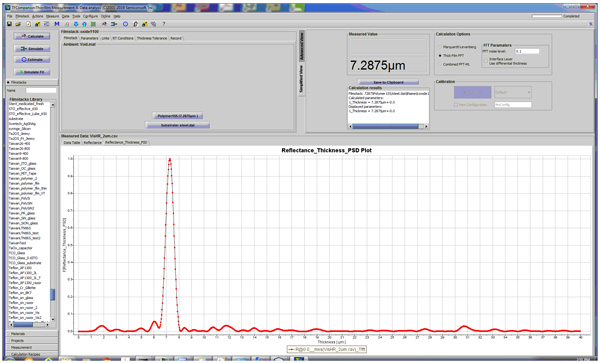
Measured with: MProbe MSP (MProbe 40).