Thickness measurement with microscope objectives
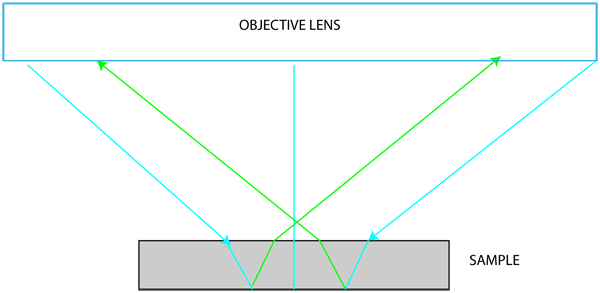
Small-spot film thickness measurement is typically done with microscope objectives, especially when the measurement must land on a patterned feature, a narrow strip or a small curved area. High numerical aperture objectives can improve imaging resolution and light collection, but they also send a wider cone of rays into the film.
High-NA objective problem
For thin-film interference, those rays travel different optical path lengths inside the layer. When the phases recombine at the detector, interference contrast can be reduced. The effect depends on the filmstack and generally becomes more important as the film gets thicker or as other artifacts, such as scattering and local thickness variation, weaken the fringes.
How NA affects thickness measurement
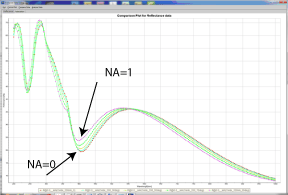
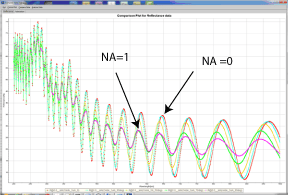
For a 200 nm oxide film, the simulated reflectance spectrum changes gradually as NA increases and the effect can usually be corrected. For a 2 µm oxide film, the same high-NA effect is much stronger, making the choice of objective more important.
What is the solution?
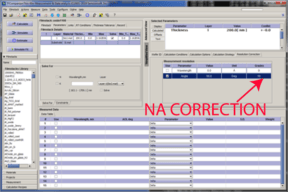
TFCompanion includes numerical-aperture correction for curve fitting. In difficult cases, however, software correction cannot recover fringes that have already disappeared, so objective choice still matters. Low-NA objectives are preferred when the measurement allows it; ideally the objective NA is below 0.5.
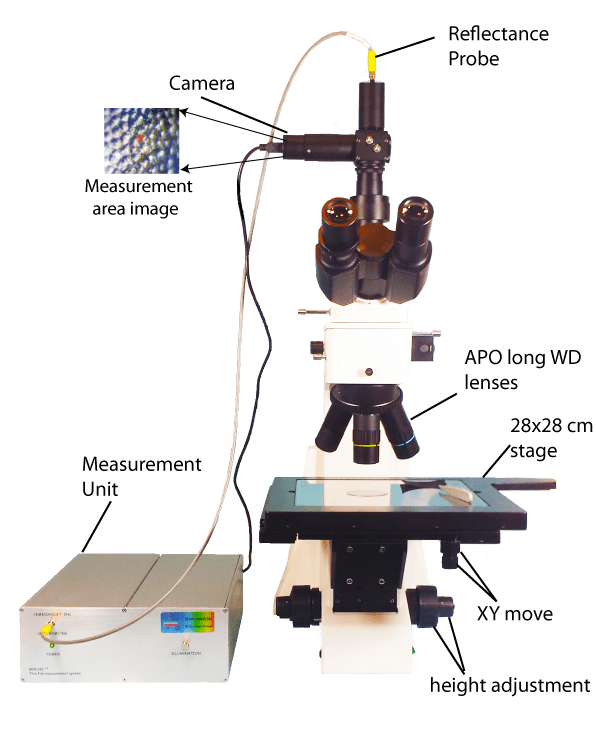
MProbe 40 MSP uses long-working-distance objectives with NA below 0.55, minimizing signal degradation for most filmstacks while keeping navigation comfortable around real samples.
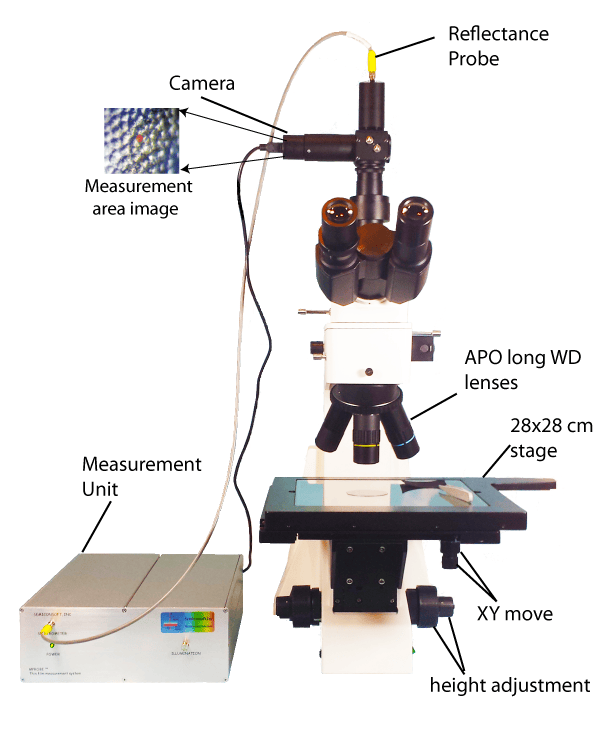
Measured with: MProbe 40 MSP (MProbe 40).