The spectrometer is a critical component of the MProbe measurement system. Its detector noise, ADC range, wavelength resolution and internal corrections determine whether small reflectance changes can be measured reliably enough for thickness and n, k analysis.
Dynamic range
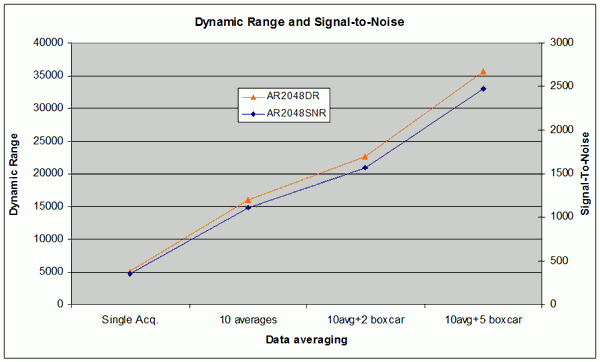
Dynamic range is the ratio between the largest and smallest measurable signals. Ariel uses a 16-bit ADC, with 65,535 counts at full scale. For the CMOS S11639 detector, read-out noise is typically about 13–14 ADC counts, giving a dynamic range of approximately 5000.
That makes it possible to measure reflectivity from 100% down to approximately 0.02%. In practice, a 0.02% signal is at the detection limit, but a reflectivity difference near 0.1% can still be measured clearly enough for model fitting.
Signal-to-noise ratio
Signal-to-noise ratio describes measurement quality by comparing signal power to noise. At high signal levels, the measurement is mainly shot-noise limited. With the S11639 detector and typical quantum efficiency, maximum SNR is about 350 before averaging.
Averaging and boxcar processing
Both dynamic range and SNR improve with averaging. The default MProbe measurement recipe uses 10 averages and a 5-pixel boxcar average, giving an effective dynamic range near 35,000 and SNR near 2500. The trade-off is increased measurement time and a small reduction in wavelength resolution.
Offset, dark signal and non-linearity
Reflectance and transmittance measurements depend on accurate reference comparison, so offset, dark signal and detector non-linearity must be corrected. Ariel performs non-linearity correction in firmware and applies calibrated dark-signal correction over operating temperature and integration-time ranges.
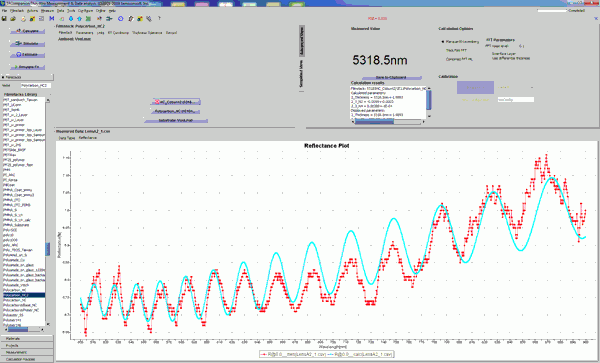
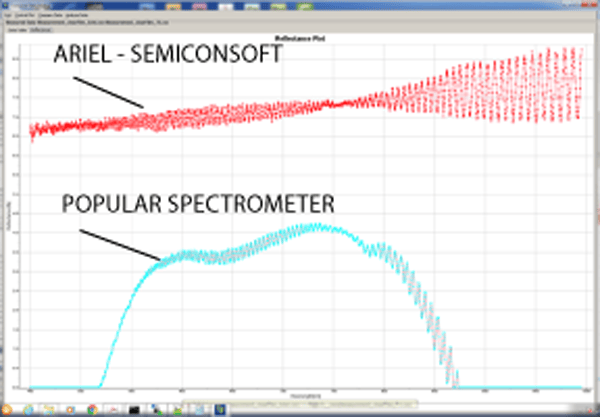
Without those corrections, a high-thickness polymer-film spectrum can be distorted by offset and non-linearity. Ariel's automatic correction keeps the spectrum usable without requiring a separate dark measurement for normal operation.
Wavelength resolution
Wavelength resolution is selected for the target thickness range. Higher resolution supports thicker-film measurement, but it usually narrows the wavelength range, which can limit sensitivity to thinner films. With a 2048-pixel detector, the visible and UV-visible ranges provide roughly 0.3–0.4 nm per pixel. With a 20 µm slit and a well-corrected optical spot, Ariel can achieve resolution below 1 nm.
Related system: Ariel spectrometer.