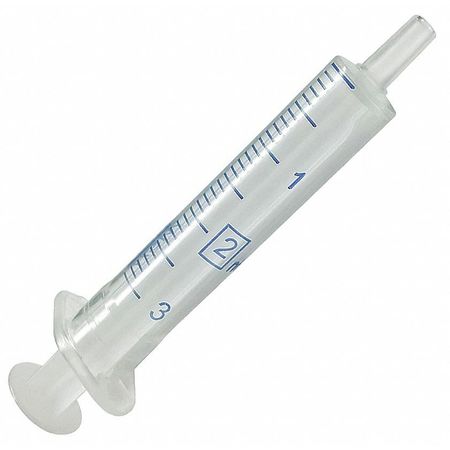
A thin silicone layer inside syringe barrels acts as a lubricant so the plunger glides smoothly, and as a hydrophobic barrier preventing drug interaction with the glass. Both inadequate and excessive siliconization cause problems, so production control of layer thickness and uniformity is essential. Medical vials are siliconized with a thinner layer.
Because of the barrel's high curvature, measurement uses a small spot (typically 20–40 µm, ~10 µm for smaller-diameter vials). Inline measurement adds a holder and automation to rotate and move the syringe for thickness mapping, with a high-power Xe flash source for fast acquisition. The 400–1000 nm range, 10 nm–50 µm thickness, suits this application.
Why use MProbe Vis MSP?
- Small-spot measurement is required because of syringe-barrel and vial curvature.
- Typical spot size is ~20–40 µm for syringe barrels and ~10 µm for smaller-diameter vials.
- Up to four objectives can be used, with calibrations stored for different configurations.
- The measurement-site image makes navigation to the desired location straightforward.
- The 400–1000 nm wavelength range is well suited for silicone layers on syringes and vials.
Basic specification
| Recommended system | MProbe Vis-MSP |
| Wavelength range | 400–1000 nm |
| Wavelength resolution | < 2 nm |
| Precision | < 0.01 nm or 0.01% |
| Accuracy | < 1 nm or 0.2% |
| Measurement time | < 100 ms typical, depending on sample reflectivity |
| Spot size | 2–200 µm, depending on objective |
| Imaging | Integrated 2 MP camera to display the measurement area |
| Automation | Custom holders and automation available |
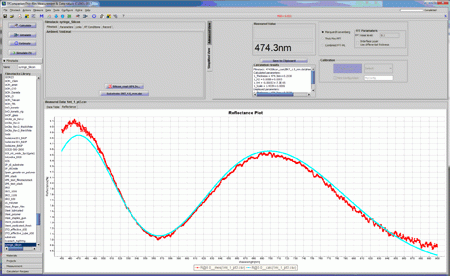
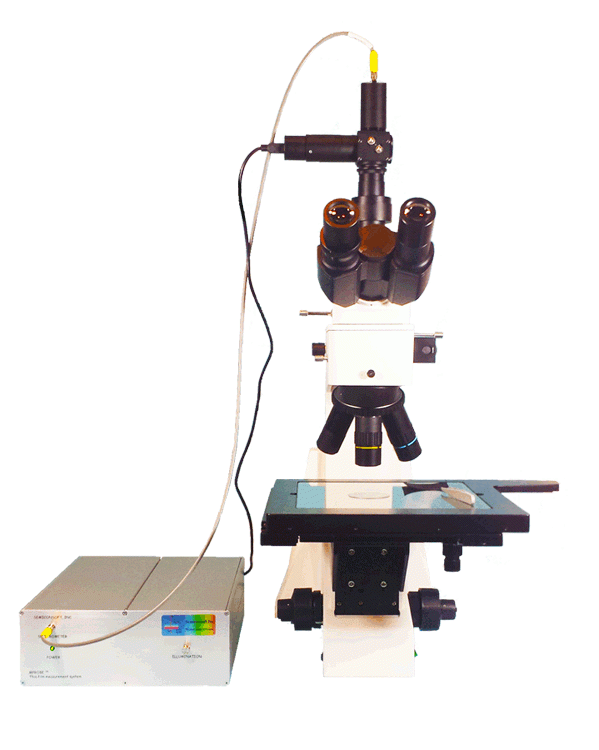
Measured with: MProbe Vis-MSP (MProbe 40).