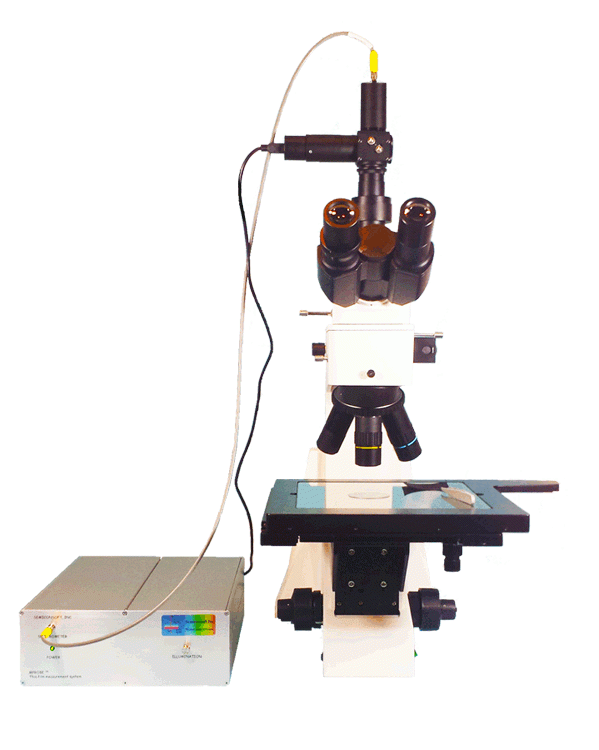
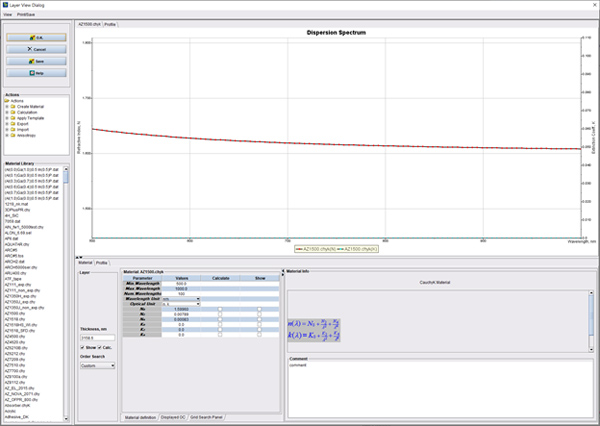
Photoresist (PR) comes in many types, thicknesses and substrates, and its thickness usually must be measured to control the process. An MProbe™ Vis reflectometer (400–1000 nm, 10 nm–50 µm) works well; illumination is typically limited with a long-pass filter (LP500 → 500–1000 nm) to avoid exposing the resist. PR dispersion is represented with a Cauchy model whose coefficients are usually on the manufacturer's spec sheet; if not, thickness and refractive index can be measured directly.
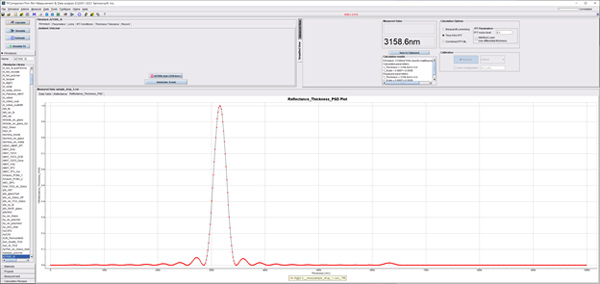
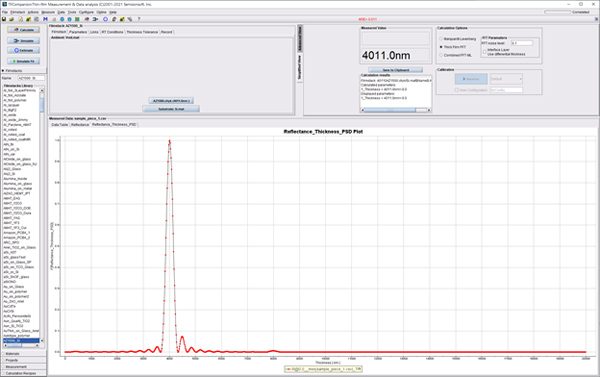
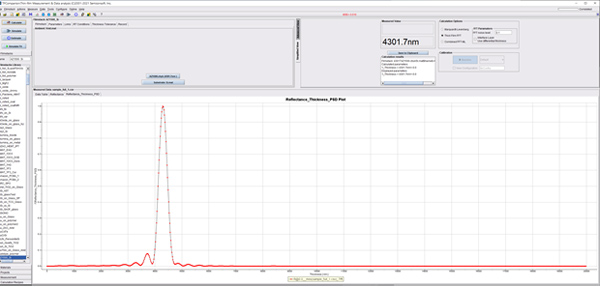
Practically any photoresist can be measured - baked, partially baked, thin or thick. For films thicker than ~1 µm you can start with the FFT thick-film algorithm, then fine-tune with curve fitting. Fully baked resist with correct Cauchy coefficients needs no adjustment; under-baked resist has different optical constants (lower density raises measured thickness), which curve fitting can determine. Once optical constants are known, FFT gives fast, foolproof results that match curve fitting within ~0.1–0.2% (FFT reads slightly high where absorption is present). Small-spot work uses the MProbe™ Vis MSP.
Measurement workflow
- Determine optical constants. Many photoresists are already defined in the material library. If dispersion parameters are available on the manufacturer's specification sheet, create a Cauchy material using those coefficients. If coefficients are not available, use a similar photoresist as the starting point or measure thickness and refractive index directly.
- Create the filmstack. The filmstack model defines the substrate and material layers, for example Si substrate / photoresist for a coated silicon wafer.
- Take the measurement. Data acquisition and data analysis are handled by TFCompanion. For films thicker than ~1 µm, the FFT thick-film algorithm gives a fast first thickness result; curve fitting can then refine the filmstack and optical constants.
Example cases
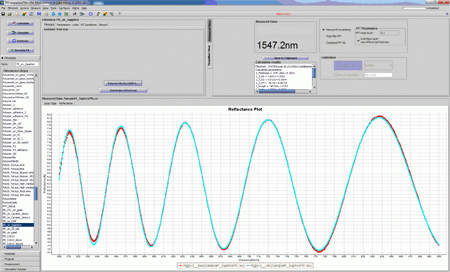
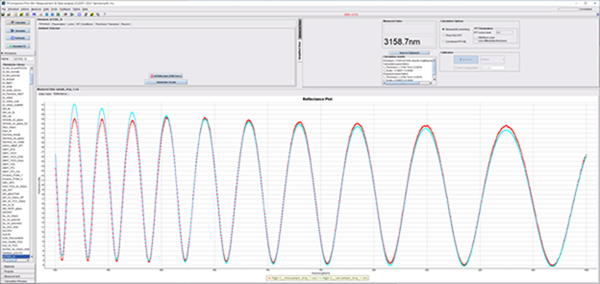
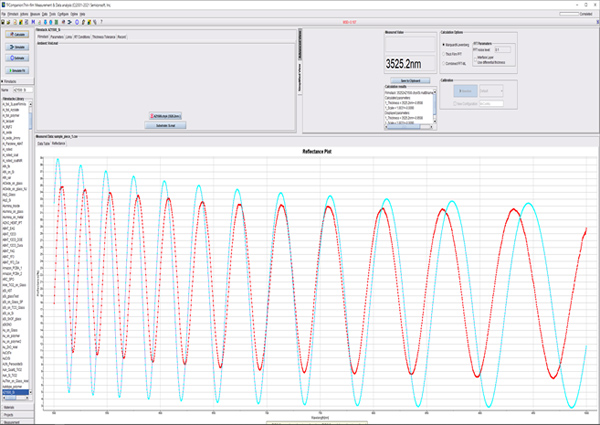
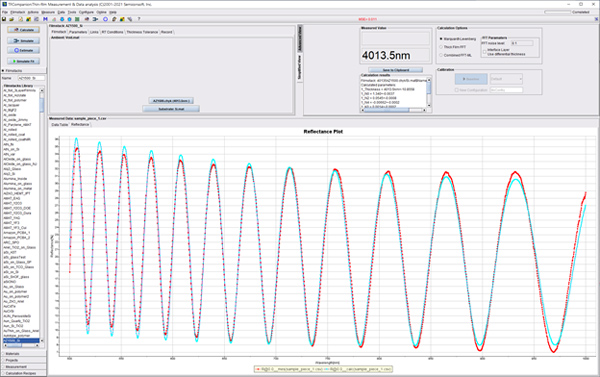
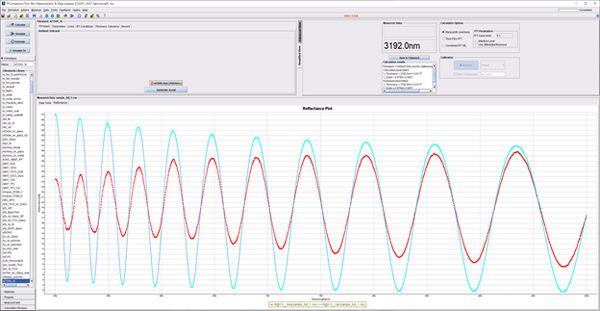
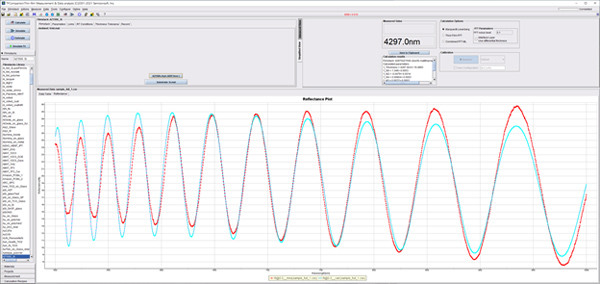
For fully baked AZ1580 photoresist on Si, the model fit is good when the correct Cauchy coefficients are used, and FFT thickness agrees closely with curve fitting. Partially baked and lightly baked samples show larger fit discrepancies because optical constants change with solvent concentration and density. Adjusting n, k improves the fit; the resulting thickness is higher for under-baked material, and FFT then agrees well with curve fitting, with small differences caused mainly by absorption.
Why use MProbe Vis or Vis-MSP?
- The 500–1000 nm measurement range is well suited for most photoresist films and can be limited to help prevent resist exposure.
- Measurement is non-destructive and results are available instantly.
- Small-spot measurement can be used when patterned areas require it.
- Thickness and refractive-index dispersion can be measured when material data are not known.
Basic specification
| Recommended system | MProbe 20 Vis; Vis-MSP for small-spot work |
| Wavelength range | 400–1000 nm; 450–1050 nm for VisX |
| Typical filtered range | 500–1000 nm with LP500 long-pass filter |
| Wavelength resolution | < 1 nm |
| Precision | < 0.01 nm or 0.01% |
| Accuracy | < 1 nm or 0.2% |
| Measurement time | < 10 ms typical, depending on sample reflectivity |
| Spot size | < 1 mm for MProbe 20 Vis; 2–200 µm for MSP depending on objective |
| Stage | SH200A with focusing lens and fine adjustment, 200×200 mm sample area |
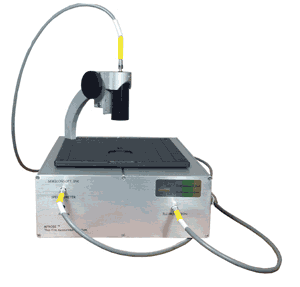
Measured with: MProbe 20 Vis / Vis-MSP (MProbe Vis, MProbe 40).